Commercial Edition
The code in this repository — pg-cdc — is a working, standalone Postgres CDC tool published under Apache 2.0. The commercial edition is a closed-source extension built by Burnside on top of pg-cdc that adds the governance, access-control, audit, and compliance features required for regulated production deployments.
This document describes what the commercial edition adds. It is informational only; the code is not distributed in this repository.
What the commercial edition adds
1. Layer-2 tag governance
A policy-as-code block (governance: in pg-cdc.yml) that maps tables and columns to a tag taxonomy. Strict mode refuses to write any resource missing a required tag; permissive mode logs and continues.
Capabilities:
- Required-tag enforcement — e.g., every resource must carry
sensitivity,domain,owner. - Pattern-matched overrides — glob rules like
clinical.*or*.audit_logassign tags declaratively. - Column-level tags — override a single column within a matched table (e.g., mark the
emailcolumnPIIwhile the rest of the table isinternal). - Emergency overrides — out-of-band tag changes carrying
reason,created_by,created_at, and a hardexpires_at. Reconciliation refuses expired entries. - JSON Schema authority — the
governance:block is pinned by a versioned schema; validation runs at config-load time so misconfigurations fail loud, not silent.
2. DynamoDB-backed ACL registry
A versioned classification store, one item per manifest resource (db.schema.table). Each item carries:
| Field | Purpose |
|---|---|
resource_id | db.schema.table identifier |
version | Monotonic; 0 = unclassified, increments on every intent change |
direct_tags | Tags set at this resource |
resolved_tags | direct_tags merged with inherited values |
state | active / archived |
last_intent_at / last_intent_by / last_intent_reason | Audit trail (RFC3339 + principal ARN + free-text justification) |
The registry is the authoritative source of tag intent; Lake Formation is treated as a projection of this store.
3. Extended CLI
The commercial binary wraps the open-source pg-cdc with an acl subcommand tree:
pg-cdc acl register <resource> [--sensitivity=...]pg-cdc acl get <resource>pg-cdc acl set <resource> --tag key=value --reason "INC-2345 …"pg-cdc acl list [--unclassified]pg-cdc acl diff # exit 2 on driftpg-cdc acl sync # exit 3 on drift healed, 0 on cleanExit codes are stable and designed for CI consumption — acl-reconcile.yml distinguishes “LF already matches intent” (0), “AWS API error” (2), and “drift healed, config reconciled” (3).
4. AWS Lake Formation reconciliation
pg-cdc acl diff computes the plan (add/remove ops) between DynamoDB intent and live Lake Formation tags. pg-cdc acl sync applies it through AddLFTagsToResource / RemoveLFTagsFromResource. Every plan item emits an audit event before apply.
Supports idempotent re-runs — the LF Add API is idempotent at the value level, so replayed plans converge rather than error.
5. Terraform infrastructure stack
Provisioning module (deploy/terraform/governance/) that stands up the full governance plane in one terraform apply:
| Component | Purpose |
|---|---|
| DynamoDB ACL table | The intent registry |
| DynamoDB Streams → Kinesis Firehose → S3 | Append-only audit pipeline (immutable log of every classification change) |
| AWS Glue database | Target catalog for registered tables |
| Lake Formation LF-Tag taxonomy | Layer-1 tag key/value namespace (e.g., sensitivity: [public, internal, confidential, PII, PHI, PCI]) |
| LF-Tag permissions | Role-keyed ASSOCIATE / DESCRIBE grants |
| GitHub OIDC provider | Keyless AWS auth for workflows |
| Per-role IAM scopes | pg-cdc worker, tag applier, ACL writer — each default-deny |
A starter root stack is shipped (deploy/terraform/governance/examples/basic/main.tf) showing the minimum variable set.
6. GitHub Actions workflows
| Workflow | Trigger | Purpose |
|---|---|---|
acl-apply.yml | Manual (workflow_dispatch) | Authoritative write path: set ACL intent in DynamoDB + reconcile to LF in one audited run |
acl-reconcile.yml | Schedule (every 6h) + manual | Periodic pg-cdc acl sync per deployment — heals drift from console edits, out-of-band writes, failed prior runs |
lf-tags-apply.yml | Manual | Ad-hoc direct LF tag operations with audit-log commit (being superseded by the ACL-driven flow) |
Each workflow commits a CSV audit row to a git-tracked log before exiting, so every tag change is traceable to actor, reason, and Actions run URL.
7. Deployment topologies
| Topology | What it stands for |
|---|---|
| HIPAA | Default-deny IAM, KMS-CMK at rest, VPC-only egress, PHI tag taxonomy, column-level LF grants, immutable audit log |
| Least-privilege | Four-pillar posture (auth, authorization, audit, observability) — the baseline non-regulated deployment |
Each topology ships with Terraform variable overlays and a deployment runbook.
8. Cross-repo contracts
A governed spec directory (docs/spec/) holds cross-repo contracts:
governance.schema.json— authoritative Layer-2 policy schema, consumed by pg-cdc validator and downstream consumers.gold-layer-contract.md— what every promoted gold-layer artifact must carry (tags, metadata, retention).
Changes to these specs go through PR review with security sign-off before implementations are adjusted.
What is not in the commercial edition
These are in open-source pg-cdc and stay there:
- WAL streaming, logical decoding, publication management
- Parquet writing, schema evolution, compaction
- Manifest format + sink adapters (filesystem, S3, GCS)
- State store (SQLite)
- AWS Glue catalog registration (generic — no governance coupling)
- Postgres-native ACL introspection (
discover --aclreadsinformation_schema) - Tag-based table filtering (
tables.tags+tables.policy)
The commercial edition depends on open-source pg-cdc — it is built as an extension, not a fork.
Governance in action
End to end, with screenshots:
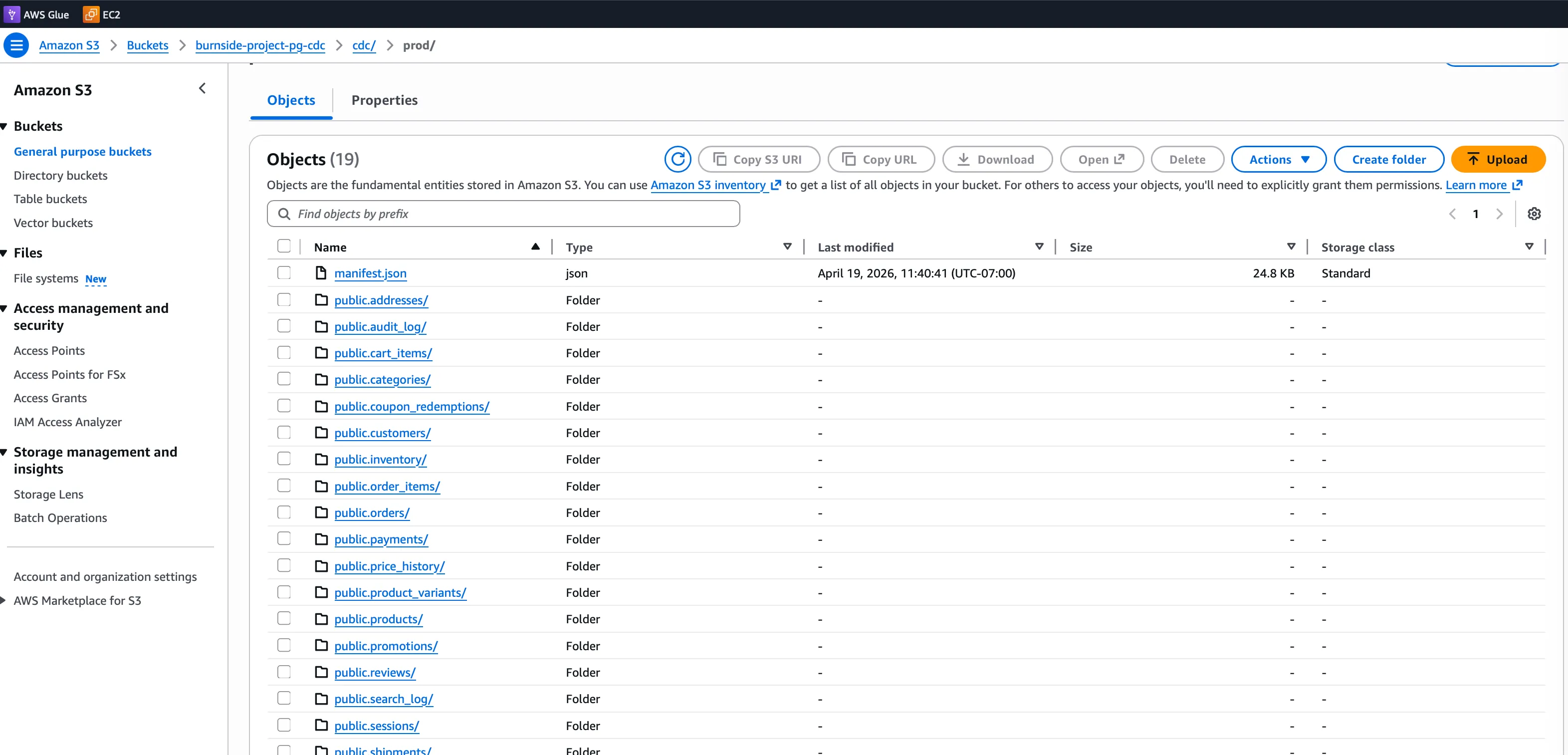
1. pg-cdc writes Parquet + manifest to cloud storage — one prefix per table, plus a top-level manifest.json describing schema and epoch ordering:
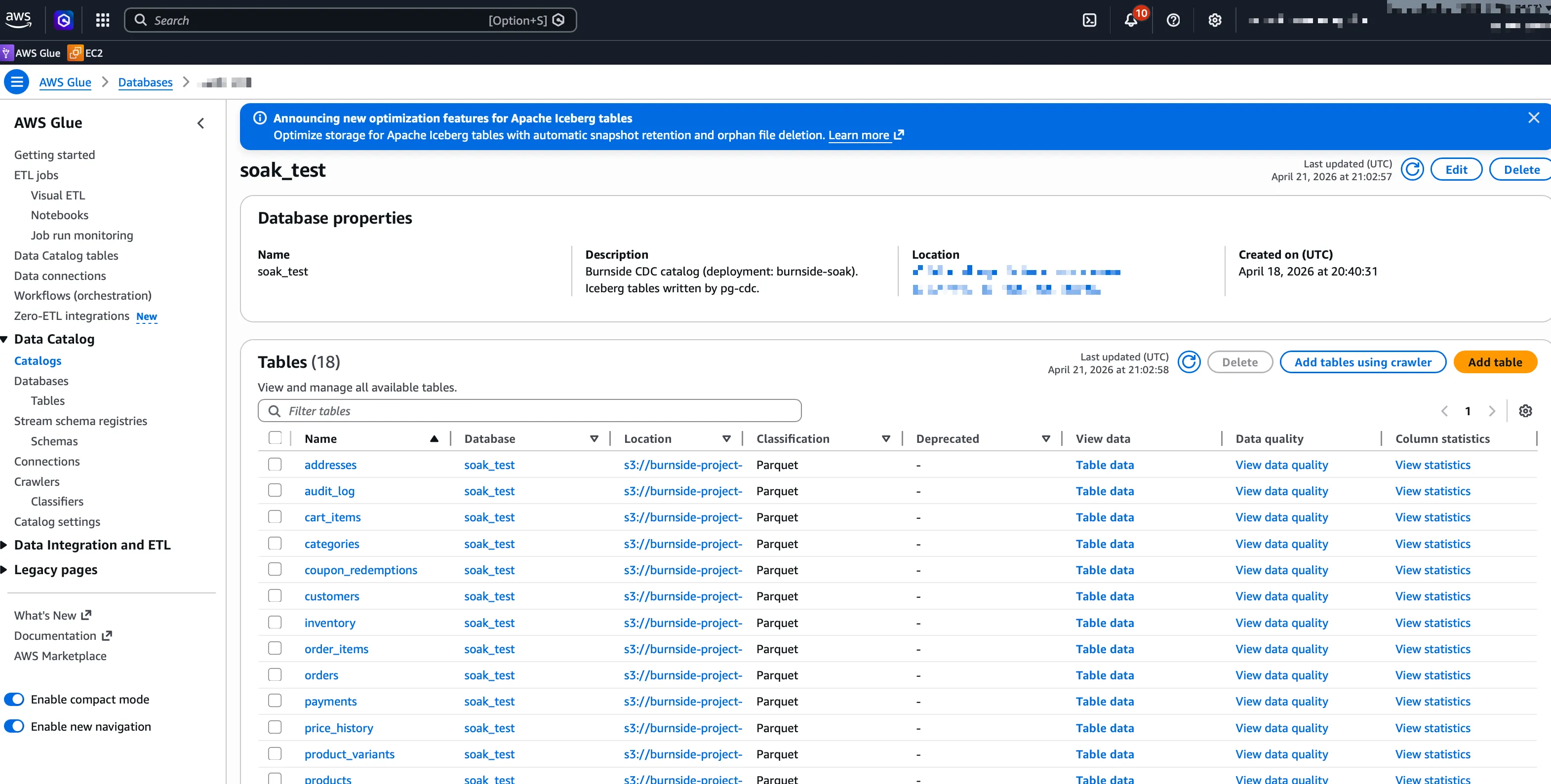
2. pg-cdc registers Parquet tables in Glue Data Catalog — the open-source catalog register command populates the catalog for downstream query engines:
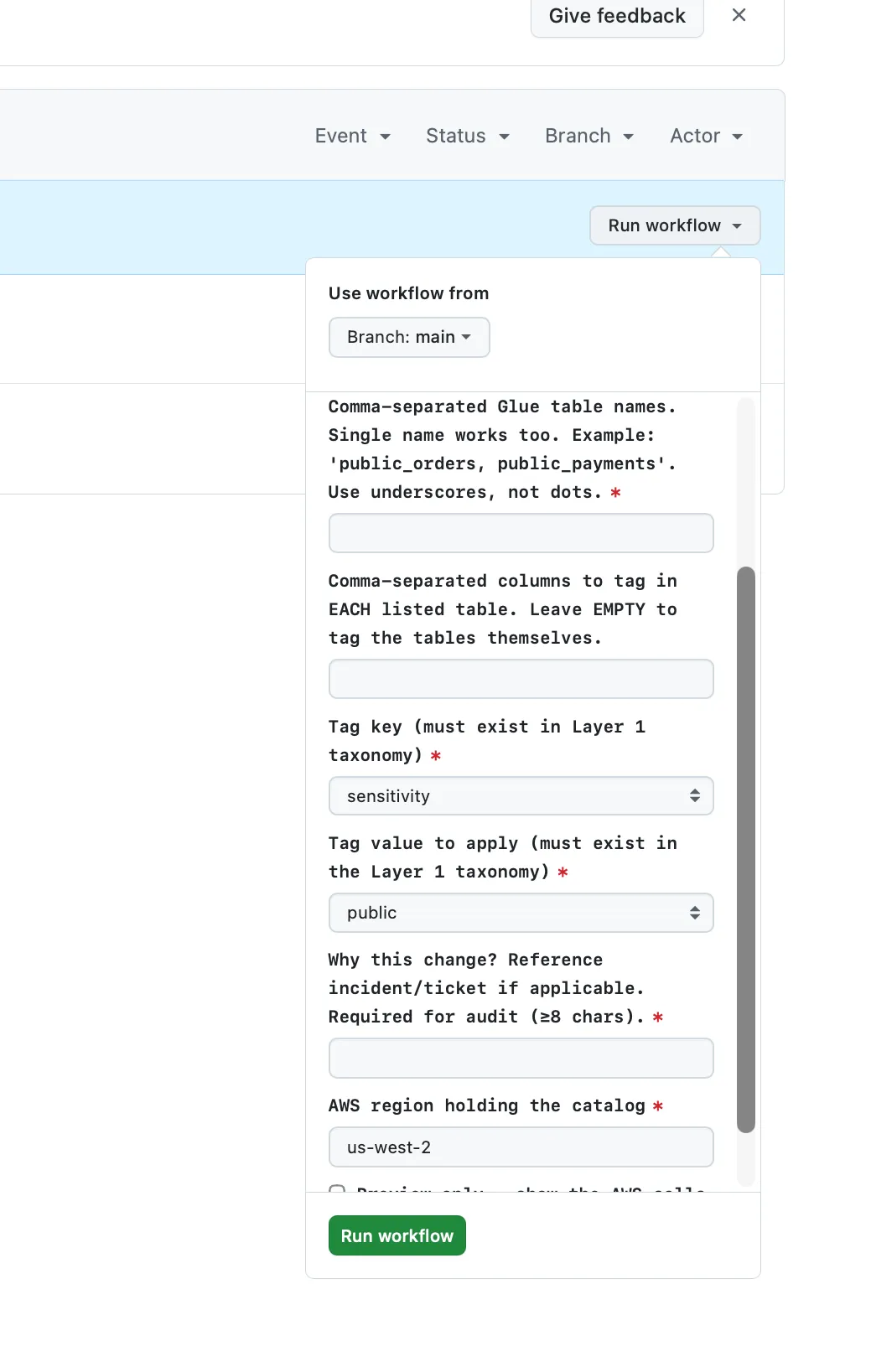
3. Operators apply ACL changes via GitHub Actions workflow dispatch — a click-ops UI that wraps pg-cdc acl set. Tag keys and values are constrained to the Layer-1 taxonomy; an audit reason (≥8 chars) is required before the workflow runs:
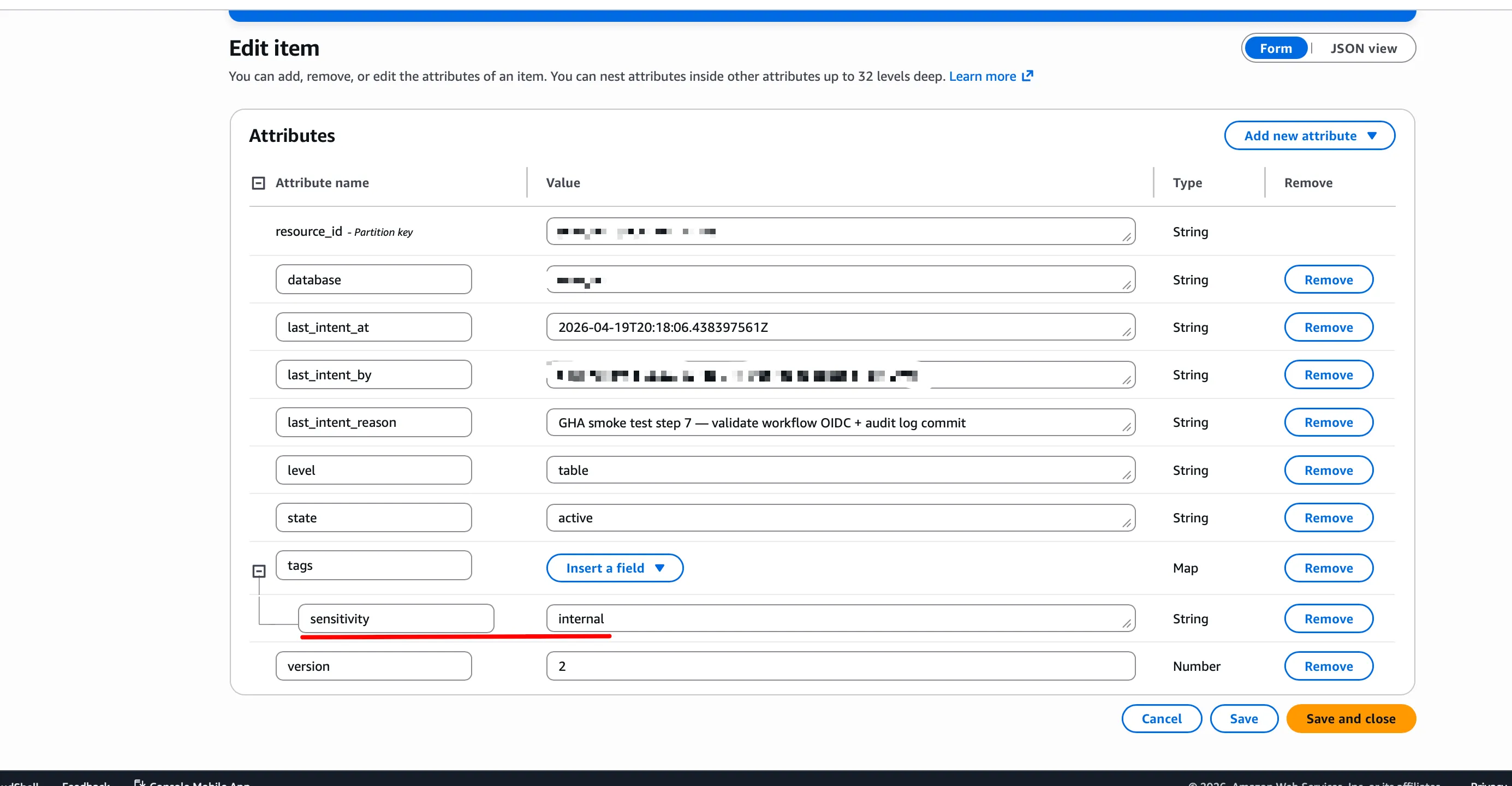
4. Governance intent is stored in a DynamoDB ACL registry — each workflow run writes a versioned record, tagged (e.g. sensitivity: internal) and stamped with actor, reason, and timestamp:
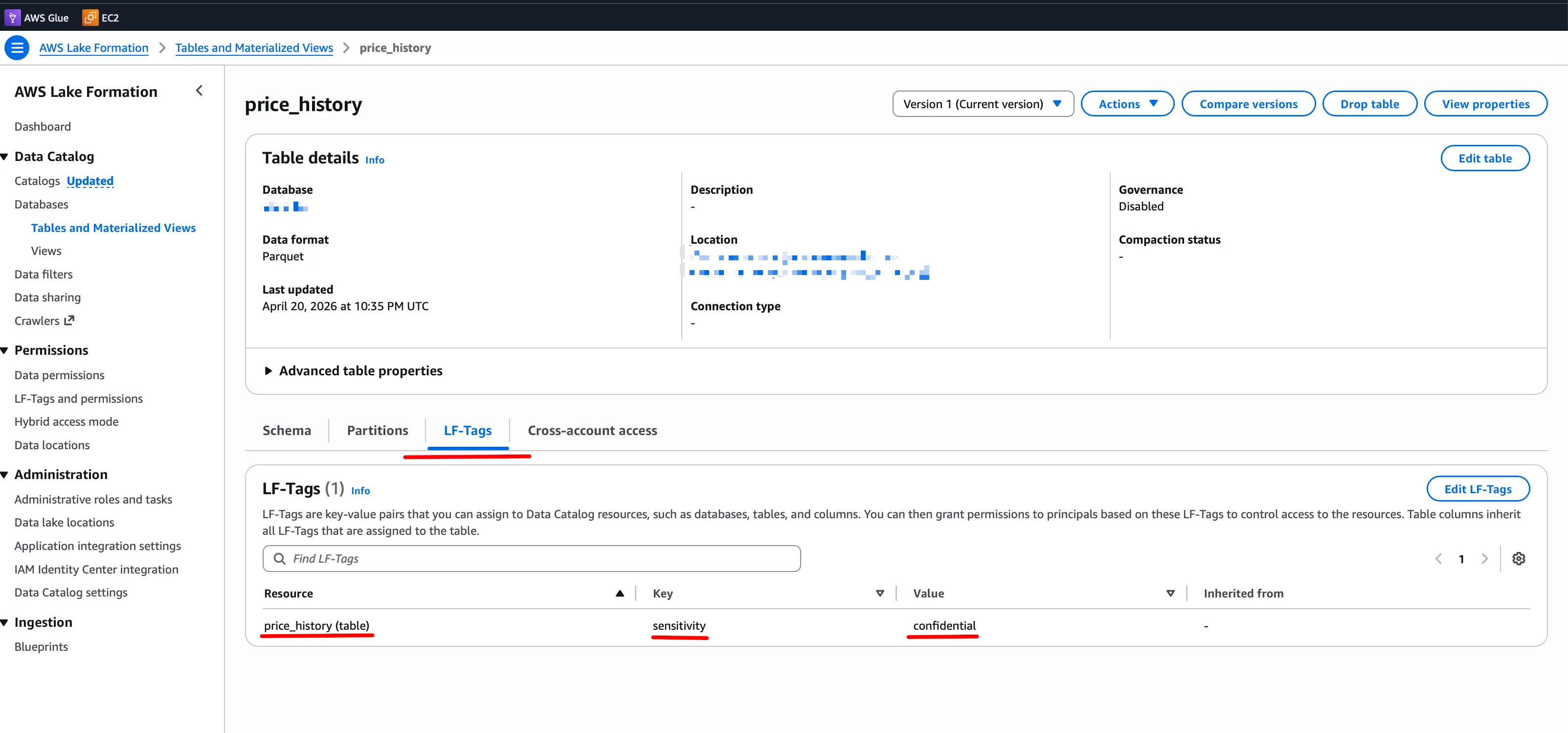
5. Tags are reconciled as LF-Tags on Glue tables — pg-cdc acl sync drives Lake Formation’s tag-based access control from the registry:
Licensing
The commercial edition is distributed by Burnside under a commercial license. For evaluation, pricing, or deployment assistance, contact your Burnside representative.